
The Final Return to Community
William TellThis flow traces how liberation becomes a shared public celebration grounded in homes, citizenship, and renewed obligations.
increasing Bearing strength in each event
 decreasing
Bearing strength in each eventdecreasingSignals Across the Mountains
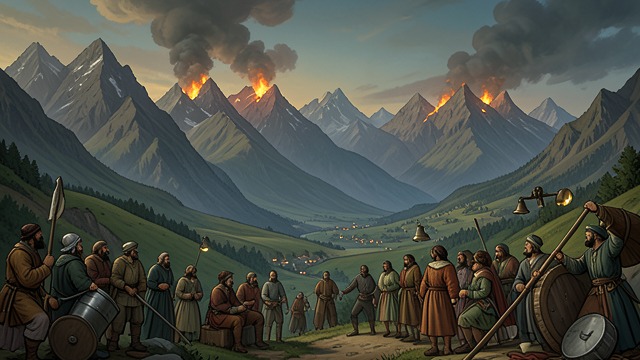
Signals Across the Mountains
News travels visually
At Altdorf, people see fires burning on distant mountain tops and hear bells ringing from the valleys. The landscape becomes a communication network connecting communities that had planned to rise together.
Local impatience
The people of Uri want to destroy the keep immediately, while Walter Furst urges them to wait for clearer reports from the other cantons. His caution reflects the coalition’s need to know that the rising has succeeded everywhere.
The scene turns geography into political coordination. The same mountains that once separated communities now carry the signs of a common action.
The Other Cantons Confirm Victory
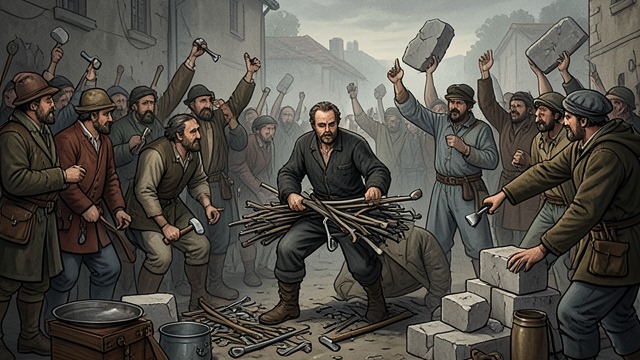
The Other Cantons Confirm Victory
News from the valleys
Arnold of Melchthal arrives with confirmation that the governors have been driven out and their strongholds taken. He explains that Rudenz helped seize Sarnen and that Rossberg has fallen.
A victory shared
The news answers Walter Furst’s concern that Uri might act alone. It allows the people to understand their local uprising as part of a successful, coordinated movement across the cantons.
The confirmation converts uncertainty into celebration. The common plan has survived the risks of secrecy, timing, and unequal local circumstances.
The Keep Torn Down
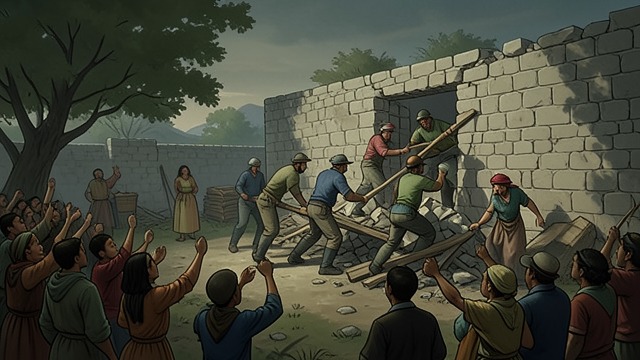
The Keep Torn Down
Builders reverse their labor
The people attack the keep, and the masons lead the destruction of the structure they had been forced to build. The labor of obedience is turned into the labor of liberation.
A public celebration
Women and children join the crowd as the scaffold and walls fall. Their participation makes the victory a communal event rather than a military claim belonging only to armed men.
The destruction gives visible form to a change in authority. A fortress built to discipline the people cannot survive once the people decide to dismantle it together.
The Cap Preserved
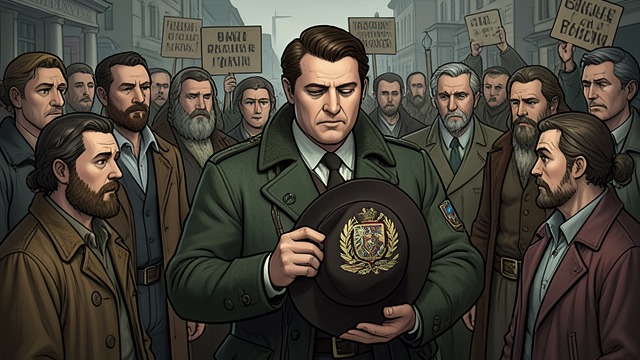
The Cap Preserved
A symbol brought back
The people present Gessler’s hat, which had once demanded a salute from passersby. They ask Walter Furst whether it should be destroyed.
A new meaning
Furst chooses preservation, arguing that the object can become a lasting symbol of the freedom won. Its history of forced deference is not erased; it is made a public reminder of how power operated.
The decision keeps memory inside the celebration. Liberation does not require forgetting oppression, but it can change who controls the signs through which oppression was performed.
Tell Welcomed Home
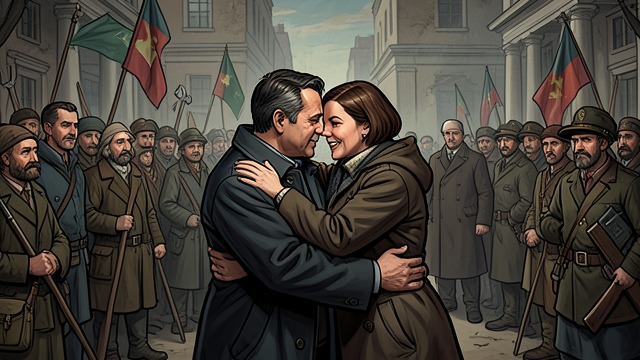
Tell Welcomed Home
A country greets its defender
The Confederates gather at Tell’s home and celebrate him as their shield and liberator. Their welcome recognizes the personal danger he endured and the service he gave to the common cause.
A public and private restoration
Tell is reunited with Hedwig and their sons while political leaders and neighbors fill the surrounding landscape. His household becomes a place where the country’s victory can be felt directly.
The ending joins national freedom to ordinary life. The struggle matters because people can return to homes, relationships, and communities no longer ruled by the expelled governors.
At dawn, near the ending
At dawn, after Melchthal arrives
At dawn, immediately after victory is confirmed
At dawn, after the keep falls
At the final gathering, outside Tell’s cottage
